
The government has revised gold import data, bringing down numbers for November by $5 billion to $9.84 billion, possibly to rectify double accounting of inbound shipments. According to revised data of the commerce ministry arm Directorate General of Commercial Intelligence and Statistics (DGCIS), gold import numbers have been slashed since April 2024, revealing excess imports of about $11.7 billion during the first eight months of 2024-25.

The new numbers show India's economic growth rate averaged 6.7 per cent during the Congress-led United Progressive Alliance regime as compared to 7.3 per cent under the present government. Previous numbers had put the average growth rate during the 10-year UPA rule at 7.75 per cent.

India's net oil import bill could widen to $101-104 billion in current fiscal from $96.1 billion in 2023-24 and any escalation in the Iran-Israel conflict could impart an upward pressure on the value of imports, ICRA said on Tuesday. The domestic rating agency said based on its analysis, lower value of Russian oil imports is estimated to have led to savings of $7.9 billion in 11 months (April-February) of 2023-24, up from $5.1 billion in 2022-23.

New estimates of India's gross domestic product (GDP) are "puzzling", Arvind Subramanian, chief economic adviser at the finance ministry, said on Friday.
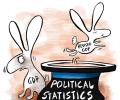
Whatever the claims about the new GDP numbers being technically superior to earlier estimates, their public credibility depends on their passing some reality checks, argues T N Ninan.

The new numbers did not apparently pass consistency checks with production, inputs, or movements in the National Stock Exchange.

Only power generation grew faster in 2014 than in earlier years.

'I am optimistic about the Budget because of the fiscal discipline the government has committed to.'

The GDP always has a base year, which defines the composition of the economy in that year. As the composition changes, the base year needs to be revised regularly. Abhishek Waghmare explains how that is done.
GDP growth in November is the second-highest since January 2012 when it had expanded 5.7%.
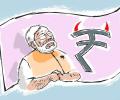
It is a classic case of extremes: The worst contraction in GDP along with the highest-ever levels of cash in the economy; and a severe dent in consumption together with strong growth in bank deposits and digital payments.

CRISIL chief economist D K Joshi is of the opinion that GDP is an indicator of the health of the economy.


India's informal economy and service sector accounts for over three-fifths of its $1.8 trillion economy.

'A broad-based revival of private sector investment was likely in 2018-19 after businesses had successfully made the switch to the GST.'

A careful reading of the national income accounts suggests that after a strong recovery from the pandemic, there has been a significant ebbing of dynamism over the last three quarters to more modest levels recently, note Arvind Subramanian and Josh Felman.
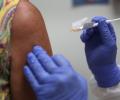
Vaccinating all citizens above the age of 18 years against COVID-19 will cost Rs 67,193 crore, of which states together will incur Rs 46,323 crore, India Ratings and Research (Ind-Ra) said on Thursday. As the second wave of COVID-19 sweeps the country with alarming speed and severity, the government has announced a liberalised and accelerated Phase 3 strategy of COVID-19 vaccination. Under this scheme, all persons above 18 years of age will be eligible to get COVID-19 vaccine doses from May 1.
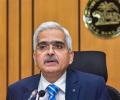
The RBI raked in a massive net income gain from foreign exchange currency sales as a buffer for the rupee during tumultuous geopolitical upheavals last year owing to Russia's invasion of Ukraine.

"The process of rectification began immediately. . . it has already begun. . . the immediate correction was already there. So far what else I can do to improve the quality of the expenditure side figures, I have already started," Chief Statistician TCA Anant said.

Of the seven surveys presented under Modi govt, predictions of three were quite close to the actual GDP growth rate, one saw the base year change in between, but the last three were way off the mark.

India's GDP had recorded 7.5 per cent growth in the April-June quarter of last fiscal.

Much of the Q3 data will simply not be available for the CSO to factor in its calculation.

UPA-II has yielded a 7.5 per cent average annual growth rate

The change in the baseline for IIP and WPI, currently at 2004-05, is expected to bring in more accuracy in mapping the level of economic activity and calculating other numbers like national accounts.
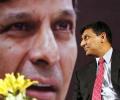
While stating that a strong government should be led by those who have expertise, motivation and integrity and can provide the needed public good, Rajan warned that "strong governments, may not, however, move in the right direction".
The real gross domestic product growth is likely to touch 9 per cent in 2003-04 based on better than expected performance of the agriculture sector, according to Centre for Monitoring Indian Economy.

The finance minister's assertion that industry should not expect any spectacular announcements in the 2024 interim Budget suggest that the electoral imperatives of more tax concessions or higher expenditure on welfarist programmes could be far less pronounced than they were before the 2019 interim Budget, expects A K Bhattacharya.

Alloting more funds for MNREGA and PM-KISAN could wipe out the entire additional money that the Centre may have for FY25.

Dreams must be accompanied with a reality check on what they actually imply.

'Healthcare is not an industry.' 'The government is only encouraging insurance as they are not able to provide healthcare to people.' 'Opening new medical colleges is not what is needed.' 'You have to invest in public sector hospitals.' 'You cannot hand over healthcare to the private industry.'

While India should be concerned about disparities, the fact is that whereas three decades ago about half the people had incomes greater than $2.15 a day, today seven out of eight do, notes T N Ninan.
"Growth is expected to moderate gradually in China... pick up in India, and remain broadly stable in the Asean-5 region."
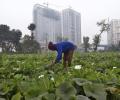
India's latest GDP numbers do not signal robust economic growth in near term.

But Indians work less than smaller countries with small populations like Bhutan, the Congo, Lesotho and Gambia.

With the government claiming that the economy has been growing robustly and the Opposition refuting these claims, the common man is none the wiser, says Rajeev Sharma.

He argued that if inflation is low, stable and moving towards the 4 per cent target, why has the RBI not revised downward the bank rate fixed in June 2023?

Search is on for reliable indicators of underlying activity.

India has allocated Rs 1.72 trillion, or 27.67 per cent of the total defence budget to cater to modernisation of the country's arsenal. Modern militaries spend up to 50 to 60 per cent of their total defence budget so that they go into combat with superior weaponry and equipment.

Investors are sceptical that the economy could have picked up so much steam.

Lead indicators suggest that domestic current account deficit (CAD) is likely to reduce in 2023, while macro-economic stability has received a boost from inflation being brought back to the official tolerance band, according to the Reserve Bank of India's (RBI's) January 2023 Bulletin. "With the merchandise trade deficit reaching an all-time high of $83.5 billion in a quarter, and a rise in net outgo from the income account, the current account deficit increased to 4.4 per cent of GDP in Q2FY23," the State of the Economy article in the bulletin said. "It is noteworthy, however, that the CAD for Q1 was revised down from 2.8 per cent to 2.2 per cent on account of downward adjustment in Customs data.
